
Newsletter Subscribe
Enter your email address below and subscribe to our newsletter

 ByJohn A
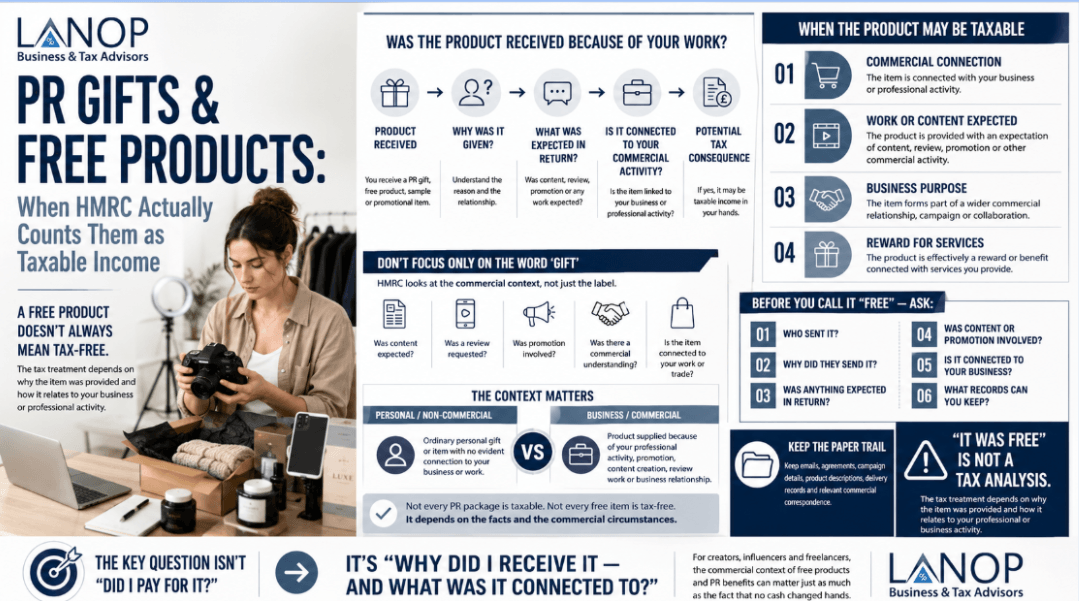
A £300 camera turns up on your doorstep. No invoice, no cash, just a note from the brand saying they love your content. Is that taxable? Most creators genuinely don’t know, and it’s exactly the kind of question accountants for influencers get asked on a weekly basis.
Not every free product is automatically taxable. But calling something a “gift” doesn’t make it tax-free either. What matters is why you received it.
This piece covers genuine gifts versus commercial arrangements, what “no obligation to post” really means, valuing a product you never paid for, the £1,000 trading allowance, gifted experiences, record keeping, and the mistakes that catch creators out most.
Sometimes, yes. HMRC doesn’t care whether you were paid in cash or in kind.if you received something of value because of your content business, with an expectation attached, that’s income. A personal gift from a friend is nothing like a product sent because you have 40,000 followers and a brief attached.
Say a brand sends a £300 camera for an agreed piece of promotional content. No cash changes hands, but you’ve still been paid just not in money. HMRC calls this payment in kind, taxed the same as cash income.
A product that arrives unsolicited, with no agreement, no obligation to promote and no content promised in return, has a much stronger claim to being a genuine gift. It’s rare in commercial creator work, but it happens.
A genuine gift comes with no business obligation attached. A commercial PR arrangement exists because the brand expects a post, review, or other content in return. None of the following alone settles it, but together they build a picture: an agreed post, a review requirement, a campaign brief, a deadline, a discount code, an affiliate link, or any kind of contract.
This phrase causes more confusion than almost anything else in influencer tax. A brand sends a product, says there’s no obligation to post, and clearly hopes you’ll feature it anyway. Contracts aren’t the only evidence HMRC looks at DMs and email threads count too. Not posting isn’t an automatic escape route either; the circumstances behind why you received it still matter.
Yes, and this catches a lot of creators off guard. DMs, WhatsApp threads, emails and verbal arrangements with an agency can all establish a commercial relationship, formal contract or not. Keep brand emails, DMs, campaign briefs and the published content itself building this habit now saves a headache later.
You can’t just write “free product £0” and move on. Use the reasonable market value at the time you received it, not necessarily whatever figure the brand quotes for marketing. Discounted or discontinued products need a sensible, evidenced estimate, and a PR box with multiple items may need each one valued separately.
This isn’t just about physical products. Complimentary hotel stays, press trips and restaurant invitations can carry the same treatment as a gifted product, if connected to your content business. What matters is the business connection, not whether you can hold the thing in your hands.
The trading allowance lets you earn up to £1,000 of relevant trading income each tax year without registering for Self Assessment and that covers cash and gifted products combined, not cash alone.
Imagine £700 in sponsorship, £200 in platform income, and £250 in gifted products. That’s £1,150 total, over the threshold even though the cash alone would have stayed under it. Crossing £1,000 doesn’t mean paying £1,000 in tax.it just means you likely need to register and report, and what you owe depends on expenses and overall profit.
Plenty of creators have a PAYE job alongside their content activity. Your employer’s payroll handles your salary tax, but says nothing about your influencer income. If creator earnings, including gifted products, cross the trading allowance, that’s a separate matter for Self Assessment.
Small gifts add up fast. £30 of skincare, £50 of clothing, £70 of beauty products and £100 of tech already comes to £250 before any cash income. A simple tracker with date, brand, product, value and whether there was an agreement makes this manageable.
Track the date received, the brand, the product, its stated and reasonable market value, whether content was expected, any agreement, relevant emails or DMs, and payments received.
Don’t panic, and don’t ignore it. Go back through your PR history, separate genuine gifts from commercial arrangements, put reasonable values on what you received, and recalculate trading income for those years. Check past Self Assessment returns and correct anything that needs fixing. Get proper advice if the position looks complicated.
HMRC has published guidance on income from online content, and platforms may have reporting obligations of their own. Non-cash income isn’t invisible just because it never touched your bank account.
Not every PR product under £50 is automatically tax-free, one of the most common mix-ups in influencer tax. A £50 threshold exists under VAT rules for business gifts, but that’s a different rule for a different purpose, never a blanket income tax exemption.
Assuming “it was free, so it isn’t income” ignores payment in kind. Believing the word “gift” settles the question ignores the actual circumstances. Assuming no contract means no tax overlooks DMs and emails. Treating everything under £50 as tax-free confuses two separate rules. Recording only cash and skipping non-cash benefits leaves a gap. And assuming £1,000 of income means £1,000 of tax confuses income with taxable profit.
Ask why you received it, whether anything was expected in return, whether there was any kind of agreement, what a reasonable value looks like, and whether you’ve recorded it. If any of that feels unclear, that’s usually the point where accountants for influencers earn their keep untangling which income counts as what, rather than guessing.
Are PR gifts taxable in the UK?
Sometimes. If a product is sent because of your content business with an expectation attached, even unspoken, HMRC generally treats it as trading income at fair value.
What if the brand says there’s no obligation to post?
That wording doesn’t settle anything alone. HMRC looks at the actual relationship, not the phrasing used in the message.
How do I value a gifted product for tax?
Use a reasonable market value at the time you received it, backed by evidence like the RRP, rather than the figure the brand quotes.
Do gifted products count towards the £1,000 trading allowance?
Yes. The allowance covers total relevant trading income, cash and gifted products combined.
What if I forgot to declare previous gifted products?
Go back through your records, work out reasonable values, and check past Self Assessment returns. Correct anything that needs fixing.
See also: How Small Businesses Can Use Cryptocurrency
Not every PR gift gets the same tax treatment. A product received through a commercial creator relationship can carry real tax implications even when no cash ever changes hands. Good records and an honest look at the circumstances behind each gift matter more than any single rule of thumb.
Don’t judge a PR package by the word “gift.” Look at why you received it, what was expected in return, what it’s actually worth, and how it fits into your wider creator income. If any of that still feels murky, Lanop Business & Tax Advisors works with creators to sort exactly this kind of thing out, so a box on your doorstep doesn’t turn into a problem on your tax return.
