
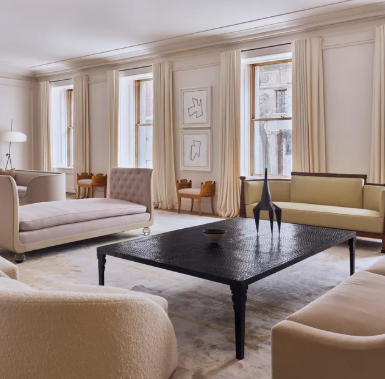

A room can be inspired by the sea without displaying a single anchor, rope knot, or ship’s wheel. The distinction between coastal art and nautical decor is important because both are often grouped under the same broad label, even though they create different effects. Nautical decor usually refers to objects and motifs connected with maritime life: boats, maps, compasses, rigging, stripes, and other recognisable references. Coastal art is broader. It can depict the physical environment of a shoreline or evoke its light, scale, weather, and atmosphere without showing any maritime object at all.
The difference becomes clear when comparing two rooms. In one, a wall may hold a ship’s wheel above a blue-and-white striped sofa, with rope details and a framed sailing map. The theme is explicit and may be exactly right for a boat owner or a room designed around maritime history. In another, a photograph of waves hangs above a linen sofa, with pale timber and a textured rug. The sea is present through the landscape and materials rather than through symbols. The second room may feel more understated, but it is not automatically more sophisticated; the choice depends on the story the space is meant to tell.
Architectural Digest’s guide to coastal interiors describes a style shaped by natural textures, soft neutrals, clean lines, and light, while its nautical decorating examples include more recognisable maritime accents. Reading the two approaches together helps explain why coastal design need not become a themed set. A room can borrow from the coast’s materials and atmosphere while keeping its objects contemporary and personal. The overview [Coastal Interior Design: Everything You Need to Know](https://www.architecturaldigest.com/story/coastal-interior-design-101) provides a useful starting point.
Art is often the easiest place to establish the difference. A photograph of a jetty can refer to human activity at the water’s edge, but it still works as a study of line and perspective. A broad view of dunes may contain no man-made object at all, yet the relationship between sand, grass, and sky can make the coastal setting unmistakable. A framed nautical chart, by contrast, communicates through information and symbolism. Neither is superior; they simply serve different visual purposes. One asks the viewer to experience a landscape, while the other often asks the viewer to recognise a maritime reference.
Before choosing artwork, consider whether you want the room to communicate a subject or an atmosphere. If you collect maritime objects, a chart or boat photograph may complement that collection. If the room already has strong patterns or themed accessories, a simple seascape may provide needed visual relief. Black-and-white photography is especially flexible because it can reference a beach while remaining compatible with modern furniture, traditional timber, or a mixed collection of older pieces. It does not insist that the rest of the room follow a single colour story.
A common mistake is to assume that coastal style requires repeated symbols. A shell bowl beside a beach picture, a blue cushion beside a sea photograph, and a rope-edged mirror may each be attractive individually, but when every object announces the same idea the room can lose depth. Choose one or two explicit references, then allow the remaining elements to be ordinary, useful, and personal. Natural texture, open space, and a carefully selected image can communicate the setting more subtly than a full set of maritime accessories.
When searching for artwork, use terms that describe the kind of image you want rather than relying only on broad style labels. A request for coastal wall art can lead to landscapes, waves, beach scenes, and shoreline architecture. A search for black-and-white beach prints narrows the choice toward tonal composition. Look at the image itself: what occupies the frame, where the eye travels, and how much atmosphere it carries. The category name is only a starting point.
Coastal art and nautical decor can also coexist. A vintage chart may sit beside a photograph of the actual coastline it describes, or a maritime object may add history to a room otherwise built around natural materials. The key is proportion. Let one element lead and allow the others to support it. When the room contains a mix of landscape, useful objects, and personal belongings, its relationship with the sea feels lived in rather than staged. That is the real distinction: not whether the decor is coastal, but whether it expresses a specific point of view.
A useful way to judge the difference is to remove the labels and describe what the image actually shows. Does it present a landscape whose appeal comes from light, scale, and texture? Or does it rely on a recognisable maritime symbol whose meaning is understood immediately? There is no need to choose only one approach. A framed chart can carry historical interest, while a seascape adds atmosphere; the two can coexist if they are given different roles. Problems arise when every item repeats the same message, leaving little room for contrast or surprise. The most inviting coastal rooms allow the sea to appear through more than one language: image, material, memory, and occasionally a well-chosen object.
