
Understanding the Importance of Moisture Control in Plastic Manufacturing
Plastic manufacturing depends on precise control over raw materials, processing temperatures, machine settings, and production conditions. One factor that can significantly influence the final product is the moisture content of plastic resin before processing. Certain polymers absorb moisture from the surrounding environment during storage, transportation, and handling. If this moisture is not removed appropriately, it can affect processing stability, surface appearance, and the mechanical properties of finished components.
For manufacturers working with engineering plastics and moisture-sensitive resins, selecting the right drying technology is an important part of quality management. Modern Dehumidifier Dryers use controlled, dry air to remove moisture from plastic granules before they enter processing equipment. These systems help establish repeatable drying conditions and support consistent material performance.
However, effective drying requires more than heating resin. Manufacturers must consider the material’s moisture absorption characteristics, the required dew point, drying temperature, residence time, and overall production demand. Understanding these factors helps businesses select equipment that meets their process requirements while managing energy consumption and operating costs.
Why Is Polymer Drying Necessary Before Processing?
Understanding Moisture Absorption in Polymers
Plastic resins respond differently to moisture depending on their chemical structure. Hygroscopic polymers absorb moisture into their internal structure, whereas non-hygroscopic materials may primarily retain moisture on their surfaces. This distinction influences the drying method required before processing.
Materials such as nylon, polycarbonate, polyethylene terephthalate, and polybutylene terephthalate may require carefully controlled drying conditions, depending on their grade and application. Moisture-sensitive resins should be dried according to the material supplier’s recommendations and the specific requirements of the manufacturing process.
Effects on Product Quality
Excess moisture can contribute to processing defects, including silver streaks, splay marks, inconsistent surface appearance, and material degradation. In some hygroscopic polymers, moisture can promote hydrolytic degradation during melt processing, potentially reducing the strength and durability of the finished component.
These problems can increase rejection rates, material waste, and the need for additional quality inspections. Proper drying helps reduce moisture-related variability, although it cannot eliminate defects caused by unsuitable processing temperatures, contaminated material, incorrect machine settings, or other production issues.
Maintaining Consistent Manufacturing Conditions
Stable material preparation supports predictable processing conditions. When resin enters a machine with an appropriate moisture content, manufacturers have better control over the variables that influence melt quality and finished-part consistency.
A well-selected drying system also helps establish repeatable operating procedures. Monitoring drying temperature, dew point, residence time, and material handling practices allows production teams to identify deviations and maintain documented quality standards.
How Do Dehumidifier Dryers Work?
The Role of Desiccant Technology
Desiccant dryers remove moisture from process air by passing it through a moisture-adsorbing material. The resulting dry air circulates through a hopper containing plastic granules, helping moisture migrate from the resin into the surrounding air.
The drying performance depends on several interconnected factors, including the dryness of the process air, airflow distribution, temperature, and the time the resin remains in the hopper. The moisture collected by the desiccant is removed through a regeneration process, allowing the drying system to continue operating.
Desiccant technology is particularly useful for hygroscopic polymers because heated air alone may not provide sufficiently low moisture levels for demanding applications.
Controlling Dew Point, Temperature, and Drying Time
Dew point indicates the temperature at which moisture in the air begins to condense under specified pressure conditions. In polymer drying, a lower process-air dew point generally indicates drier air that can support more effective moisture removal from suitable resin materials.
Temperature and drying time must also be matched to the resin. Excessive temperature can damage certain materials, while insufficient residence time may leave too much moisture in the granules. Manufacturers should follow validated material specifications rather than applying a single drying setting to every polymer.
What Should Manufacturers Look for in a Polymer Dryer?
1. Compatibility With Resin Requirements
The first step is identifying the polymers being processed, their grades, initial moisture levels, and target moisture specifications. Different resins can require different drying temperatures and residence times, so equipment selection should reflect the actual material mix.
Manufacturers should also consider future production requirements, including changes in resin grades, throughput, and product specifications. Selecting equipment based only on current average demand may limit operational flexibility as production expands.
2. Suitable Airflow and Drying Capacity
A dryer must supply sufficient dry air to remove the expected moisture load while maintaining the required conditions throughout the hopper. Capacity should be assessed in relation to material throughput, resin bulk density, drying time, and the production machine’s consumption rate.
Poor airflow distribution or inadequate capacity can create uneven drying. Conversely, an unnecessarily large system may increase capital costs and energy use. A technically appropriate configuration balances performance with practical production needs.
3. Temperature and Dew Point Monitoring
Monitoring helps operators verify that the dryer is functioning within its specified operating range. Temperature sensors, dew point meters, alarms, and suitable control systems can support routine checks and faster identification of performance deviations.
Maintenance and calibration are equally important. A sensor that provides inaccurate readings can make an otherwise capable system difficult to control. Manufacturers should establish monitoring procedures and retain records where required by their quality management programme.
How Can a Polymer Dryer Improve Energy Efficiency?
Drying equipment can contribute significantly to the energy requirements of plastic processing. Manufacturers should therefore evaluate energy consumption alongside drying performance, reliability, and material quality.
Waterless Drying Technology
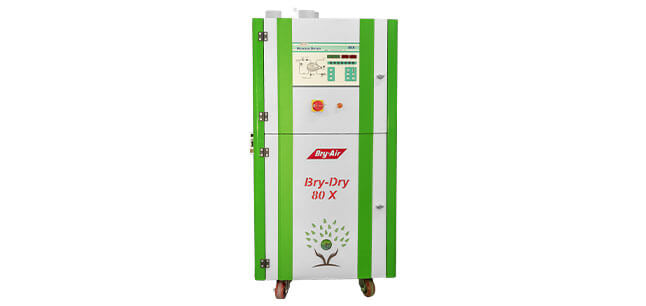
Bry-Air’s Wonder Dryer is designed as a waterless plastic drying solution for modern resin processing. Its published product information describes a system capable of achieving a dew point below minus 40°C, including at high return-air temperatures under specified operating conditions.
The product design eliminates the need for a chiller or heat exchanger and their associated pipelines in the intended configuration. This can simplify installation and reduce dependence on cooling-water infrastructure. Actual energy performance will depend on the operating conditions, selected model, resin requirements, and existing plant configuration.
Evaluating Operating Costs
A complete cost assessment should include electrical consumption, maintenance, installation, cooling-water requirements where applicable, and the cost of rejected material. Manufacturers should compare systems using equivalent production rates and drying specifications to avoid misleading comparisons.
Bry-Air states that Wonder Dryer technology can reduce operating costs by up to 40%. This is a manufacturer-published potential benefit rather than a guaranteed saving for every facility. Businesses should confirm expected performance against their specific process requirements and operating data.
What Are the Best Practices for Effective Polymer Drying?
Establish Material-Specific Drying Parameters
Each resin should have documented drying requirements based on reliable technical information. These parameters may include temperature, residence time, process-air dew point, and the permissible moisture content before processing.
Production teams should verify that operating settings remain suitable when resin grades or suppliers change. Clear procedures reduce the likelihood of using inappropriate settings that could compromise material quality.
Protect Resin During Storage and Transfer
Drying performance can be undermined if resin absorbs moisture again before reaching the processing machine. Containers, hoppers, conveying lines, and transfer points should be managed to minimise unnecessary exposure to ambient air.
Covered storage, suitable material handling, and properly maintained conveying equipment help preserve the condition of dried resin. The time between drying and processing should also be considered when defining the material handling procedure.
Maintain Equipment and Review Performance
Regular inspection helps maintain reliable dryer operation. Filters, seals, sensors, desiccant components, and air passages should be checked according to the manufacturer’s maintenance guidance.
Manufacturers should also review production data, material rejection rates, and drying performance over time. These records can help identify recurring issues, confirm whether the selected capacity remains appropriate, and support continuous improvement.
Why Choose an Engineered Drying Solution?
Choosing a polymer dryer involves balancing resin requirements, throughput, energy use, maintenance, and available installation space. A supplier should be able to explain the system’s operating principles, provide relevant technical specifications, and help determine whether the equipment suits the intended materials and production conditions.
Bry-Air offers plastic drying technologies designed for different processing requirements, including its Wonder Dryer range. Its product information provides guidance on resin types, drying temperatures, drying times, and equipment capacities. Manufacturers should consult the technical team to confirm the appropriate configuration rather than selecting a model based solely on nominal capacity or general efficiency claims.
Conclusion
Effective polymer drying is essential for controlling moisture-related defects and maintaining consistent plastic processing quality. The right drying system combines suitable desiccant technology, appropriate airflow, material-specific temperature settings, adequate residence time, and reliable monitoring. These factors help manufacturers prepare resin more consistently while managing waste, operating costs, and production efficiency.
Waterless drying technology can offer additional advantages where the system configuration suits the facility’s requirements. Before investing in equipment, manufacturers should evaluate their resin specifications, throughput, installation conditions, and long-term operating objectives. To discuss suitable drying technologies and application requirements, manufacturers can Contact Us and consult Bry-Air’s team for guidance on selecting an appropriate solution.